
Basketball Rules Explained: Overview
Basketball is played by two teams of five players on court.[1] Each team tries to score in the opponents’ basket while preventing the other team from scoring; the team with more points at the end wins (FIBA Articles 1.1, 1.4, 4.2.2).[1]
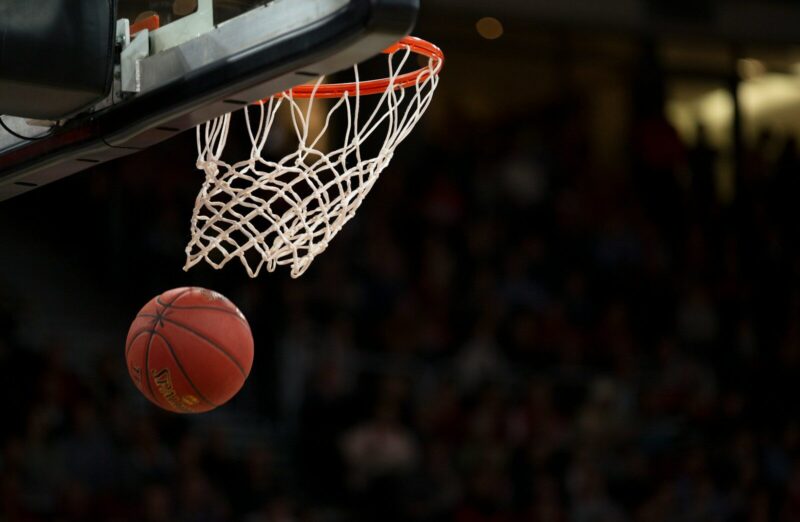
Which rules does this explain? FIBA five-on-five basketball, using Official Basketball Rules 2026 v1.1, effective 1 October 2026, and Official Interpretations 2026 v1.0.[1][2][8] FIBA’s downloads page lists those editions as of the source check on 15 October 2026.[1][2][8]
Do not apply this unchanged to the NBA, NCAA, WNBA, school, youth or 3×3 basketball. NBA differences appear only in labelled comparison sections. For a particular competition, confirm its adopted rules and any competition-specific variations with the organiser.
The rules at a glance
| Question | FIBA answer | Official reference |
|---|---|---|
| How many players? | Five per team on court; up to 12 team members entitled to play on the team list. | Articles 4.2.1–4.2.2.[1] |
| How long? | Four 10-minute quarters; repeated five-minute overtimes when needed. | Articles 8.1, 8.7.[1] |
| What is a basket worth? | One point for a free throw, two from the two-point area, three from the three-point area. | Article 16.2.1.[1] |
| How long to shoot? | Normally 24 seconds; specified resets use 14 seconds. | Articles 29.1.1, 29.2.[1] |
| How long to cross halfway? | Eight seconds to cause the ball to enter the frontcourt under the rule’s tests. | Article 28.1.[1] |
| How many fouls before a player leaves? | Five fouls; disqualification can occur earlier for specified conduct. | Articles 41.1, 36.2.3, 38.2.3.[1] |
| When do team fouls mean free throws? | After four team fouls in a quarter, following qualifying non-shooting personal fouls normally mean two free throws; team-control fouls are an exception. | Article 42.[1] |
| What happens on a held ball? | A jump-ball situation, normally resolved by alternating-possession throw-in. | Articles 12.1.2, 12.4, 12.6.1.[1] |
Who governs basketball, and which rules apply?
FIBA publishes the international rules and its member federations have national responsibilities.[9][21] NBA and WNBA publish their own official resources.[20][23] NCAA men’s and women’s basketball and NFHS school basketball have separate rules resources.[16][17][13] FIBA 3×3 has its own official rules and documents.[14] This hub uses FIBA five-on-five as its stated baseline, not a universal basketball code.
Use Basketball governing bodies: which rules apply? to distinguish rule writers from competition organisers, find primary official links and see verified examples of different rulings. It covers major bodies, not an exhaustive worldwide directory. Do not apply FIBA’s five-on-five foul system to a different code just because both games are called basketball.
Start with the four practical guides
- Scoring, game time and overtime: two or three points, buzzer-beaters, shot-clock resets and late-game timing.
- Fouls and free throws: shooting fouls, the team penalty and the important 2026 foul changes.
- Travelling and double dribble: pivot feet, step counting, fumbles and second dribbles.
- Out-of-bounds, restarts and possession: line calls, five-second throw-ins and the possession arrow.
How a possession works
A team controls the ball when one of its players holds or dribbles a live ball, or has a live ball at their disposal.[1] Team control continues during passes between teammates, and ends when the opponents gain control, the ball becomes dead, or the ball leaves a player’s hands on a shot or free throw (Articles 14.1.1–14.1.3).[1]
That distinction matters: a defensive fingertip on a pass does not automatically establish a new possession, while a shot release ends team control even though the shooting team may get the rebound (Articles 14.1.3, 51.1).[1]
A typical sequence
Illustrative example: A gains control in its backcourt, legally advances into the frontcourt, shoots before the shot-clock signal and hits the ring.[1] A teammate rebounds.[1] The original advance had to satisfy the eight-second rule, the shot had to leave the hand before the signal and hit the ring or go in, and A’s ring-touch rebound gives a 14-second shot-clock reset (Articles 28.1, 29.1.1, 29.2.7).[1]
Moving the ball legally
Players can pass, shoot and dribble.[1] A player holding the ball must obey the pivot-foot and step rules; a player whose dribble has ended cannot simply begin another one unless a defined loss-of-control exception applies (Articles 13.1, 24.2, 25.2).[1]
The familiar phrase “you get two steps” is incomplete.[1] A stationary catch has pivot-foot rules, a moving catch has its own release requirement when starting a dribble, and some two-foot stops leave the player with no right to pivot (Article 25.2.1).[1]
The other common timing violations
- Offensive three seconds: a player cannot remain in the opponents’ restricted area for more than three consecutive seconds while their team controls a live ball in the frontcourt and the game clock is running. Allowances include trying to leave and specified shooting situations (Articles 26.1.1–26.1.2).[1]
- Closely guarded five seconds: a player holding the ball, actively legally guarded within one metre, must pass, shoot or dribble within five seconds. This is not a general five-second limit on every possession (Article 27).[1]
- Backcourt return: once a team has frontcourt control, its last touch in the frontcourt followed by its first touch in the backcourt can be a violation. New airborne control followed by landing in the backcourt has an express exception (Articles 30.1.1–30.1.2).[1]
- Deliberate leg contact: deliberately kicking or blocking the ball with the leg is a violation; accidental leg contact is not (Article 13.2).[1]
A violation is not the same thing as a foul
A violation is an infraction such as travelling, double dribble or an out-of-bounds violation.[1] Unless a more specific rule applies, the opponents get a throw-in nearest the infraction, not directly behind the backboard (Article 22).[1]
A personal foul involves illegal contact.[1] Do not assume every touch is illegal: cylinder, verticality and legal-guarding principles determine responsibility for contact (Articles 33.1–33.4, 34.1.1).[1]
Illustrative example: a defender establishes legal guarding position and then moves laterally to maintain it.[1] The defender does not automatically commit a blocking foul merely because their feet are moving; direction, established position and the place of contact matter (Article 33.4).[1]
Important: the FIBA foul system changed in 2026
Do not reuse a 2024 explanation of “unsportsmanlike fouls” as if it were the current FIBA system.[1][3] The 2026 edition introduces disruptive fouls and flagrant fouls, and separates category 1 from category 2 technical fouls for game-disqualification purposes (Articles 36–38; FIBA’s change announcement).[1][3]
A disruptive foul still counts toward the player’s five-foul limit and the team total, but does not itself count toward the specified technical/flagrant accumulation for game disqualification.[1][2] Two category 1 technicals, two flagrants, or one of each disqualify a player; category 2 technicals do not count toward that accumulation (Articles 36.2.1, 36.2.3, 37.2.1, 41.1; OBRI 37-1).[1][2]
Scoring, the basket and the boundary lines
A legal goal enters from above and passes through or remains in the basket.[1] The three-point line is not part of the three-point area, so a shooter touching that line has not released from the three-point area (Articles 16.1.1, 16.2.1, 2.5.4, 11.1).[1]
A sideline or endline is out of bounds.[1] An airborne player retains the location of their last floor contact, so jumping from outside and catching before landing inbounds does not rescue the ball (Articles 11.1, 23.1).[1]
Goaltending is also restricted: on a field-goal shot, touching the ball completely above ring level while it is descending toward the basket, or after it has hit the backboard, can be goaltending.[1] Separate basket-interference provisions also apply; a ring touch is not permission to touch the ring or interfere with the basket in any way (Articles 31.2.1–31.2.4).[1]
Stoppages, substitutes and time-outs
Each FIBA time-out lasts one minute.[1] Teams may receive two in the first half, three in the second half subject to a maximum of two at 2:00 or less in the fourth quarter, and one per overtime; unused allowances do not carry into the next half or overtime (Articles 18.2.1, 18.2.5–18.2.6).[1]
The head coach or first assistant requests a time-out at the table; it must be granted during an eligible opportunity.[1] A player cannot simply call a FIBA time-out while dribbling (Articles 18.2.2–18.2.4, 18.3.1).[1]
Substitutes request entry at the table and must wait for the referee to beckon them on.[1] Opportunities normally arise when the ball is dead, the clock is stopped and the referee has finished communicating with the table; special opportunities include a successful last free throw and, for the non-scoring team, a made basket at 2:00 or less in the fourth quarter or overtime (Articles 19.2.2, 19.3.1, 19.3.4).[1]
FIBA versus NBA: verified differences only
These are separate codes, not optional interpretations of the same rule.
| Topic | FIBA 2026 | NBA official online rulebook |
|---|---|---|
| Regulation quarters | 10 minutes, Article 8.1.[1] | 12 minutes, Rule 5 §II(a).[4] |
| Overtime duration | Five minutes, Article 8.7.[1] | Five minutes, Rule 5 §II(b); repeated overtime under §IV.[4] |
| Team-foul treatment in overtime | Overtime fouls count in the fourth-quarter total, Article 42.1.3.[1] | Separate overtime quota: common team fouls beyond three attract the penalty, with a last-two-minutes provision, Rule 12B §V(a).[6] |
| Uncertain last touch out of bounds | Jump-ball situation resolved by alternating possession, Articles 12.4, 12.6.1.[1] | Jump ball between involved players, subject to the rule’s stated exceptions, Rule 8 §II(d).[7] |
| Catching your own airball | A genuine shot can permit regaining the ball and a new dribble; OBRI 24-4–24-5.[2] | The shooter cannot be first to touch a shot that has not touched backboard, ring or another player, Rule 10 §XIII(f).[5] |
The NBA pages used here were retrieved on 15 October 2026. They do not establish a dated “2026–27 edition” or commencement date in the retrieved text; these comparisons describe the official online text, not an independently verified season-specific release.
Quick answers
Does the clock stop after every basket?
No.[1] In FIBA, a made basket stops the clock at 2:00 or less in the fourth quarter and each overtime; it also stops when scored against a team that has requested a time-out.[1] Other stoppage conditions still apply (Article 50.2).[1]
Does a held ball mean another centre jump?
Normally no.[1] It is a jump-ball situation resolved using alternating possession; the game’s opening jump ball establishes which team gets the first arrow entitlement (Articles 12.4, 12.6.1–12.6.2).[1]
Does every fifth team foul mean free throws?
Not every kind of foul.[1] The team-penalty rule gives two for qualifying later non-shooting personal fouls, but a personal foul by the team controlling or entitled to the ball is a throw-in for the opponents.[1] Shooting, throw-in, technical, disruptive and flagrant fouls have their own provisions (Articles 34.2, 36–38, 42.2).[1]
About this guide
OfficialRule is an explanatory guide, not a governing body or an official decision on a particular match. Examples labelled illustrative apply the cited rules; named OBRI examples are official interpretations. Sources were checked on 15 October 2026. No independent referee review is claimed. Consult the linked rulebook and your competition’s regulations for a disputed decision.
Edition record and verified change notes
Current code: basketball · FIBA five-on-five · Official Basketball Rules 2026 v1.1 · effective 1 October 2026. This stable current overview is not a historical edition archive.
FIBA’s official 2026 announcement explains the replacement of the previous unsportsmanlike-foul structure with separate disruptive and flagrant fouls and the two technical-foul categories. These are actual rule changes; the 2026 provisions must not be retroactively described as the older code. Read the official FIBA change announcement and the current foul guide.
Replacing earlier generic or inaccurate site explanations is an editorial correction, not proof that the sport’s law changed on the CMS modification date. Rollback backups are not validated historical editions. Source-verified older editions and year/code navigation are a separate next phase; no interactive comparison is available yet.
Sources
- Source [1] https://assets.fiba.basketball/image/upload/documents-corporate-fiba-official-rules-2026-v1-1.pdf
- Source [2] https://assets.fiba.basketball/image/upload/documents-corporate-fiba-official-rules-2026-interpretations-v1-0.pdf
- Source [3] https://about.fiba.basketball/en/news/fiba-official-basketball-rules-2026-to-take-effect-october-1
- Source [4] https://official.nba.com/rule-no-5-scoring-and-timing
- Source [5] https://official.nba.com/rule-no-10-violations-and-penalties
- Source [6] https://official.nba.com/rule-no-12-fouls-and-penalties
- Source [7] https://official.nba.com/rule-no-8-out-of-bounds-and-throw-in
- Source [8] https://about.fiba.basketball/en/services/resource-hub/downloads
- Source [9] https://about.fiba.basketball/en/our-sport/official-basketball-rules
- Source [13] https://www.nfhs.org/sports/basketball/rules
- Source [14] https://fiba3x3.com/en/rules.html
- Source [16] https://www.ncaa.org/championships/playing-rules/mens-basketball-playing-rules
- Source [17] https://www.ncaa.org/championships/playing-rules/womens-basketball-playing-rules
- Source [20] https://official.nba.com/rulebook
- Source [21] https://assets.fiba.basketball/image/upload/documents-corporate-fiba-regulations-general-statutes-2025-eng.pdf
- Source [23] https://www.wnba.com/wnba-rule-book