
Swimming explained: strokes, distances, medleys and relay basics
Competitive pool swimming compares valid times over the announced distance. Athletes must start, remain and finish in the allocated lane and complete the course; prescribed stroke and wall-contact requirements apply throughout. This guide uses World Aquatics February 2026 Part Two, not open-water or recreational-pool etiquette.[50]
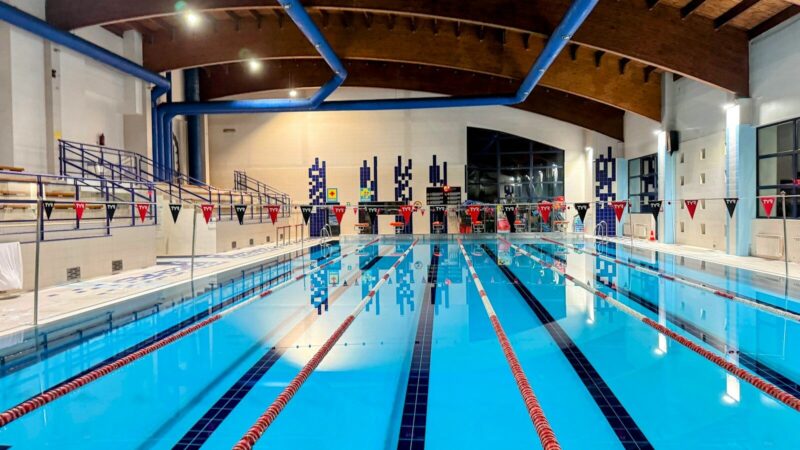
Four strokes
Freestyle: any style in an ordinary freestyle race, with a wall touch by some part of the body each length/finish and the specified surfacing rule. In a medley it means a style other than the preceding three and requires the body on the breast except the permitted turn transition (5; 9).[50]
Backstroke: start in the water facing the starting end, then swim on the back except the legal turn. Turning over uses the immediate continuous turn action; return to the back on leaving the wall and finish touching while on the back (6).[50]
Breaststroke: simultaneous arms, simultaneous legs, one arm stroke then one kick per normal cycle, with special start/turn pullout. Turns and finish require simultaneous separated hands (7).[50]
Butterfly: simultaneous forward recovery of both arms over water and simultaneous backward pull underwater, with simultaneous leg movements and no breaststroke kick. It has its own underwater/start/turn and two-hand-touch provisions (8).[50]
A length is not the same as a lap in casual speech
The event specifies metres, not an ambiguous conversational lap count. A 100m swim in a 50m pool has two lengths; in a 25m pool it has four. Additional turns change the performance context, so short-course and long-course times are not one interchangeable record list (Part Two 1; 12; 15).[50]
Medley order
| Format | Order |
|---|---|
| Individual medley | Butterfly, backstroke, breaststroke, freestyle |
| Medley relay | Backstroke, breaststroke, butterfly, freestyle |
Each stroke is one quarter of the distance and must finish according to that stroke’s rule. The backstroke-to-breaststroke transition is a backstroke finish, not permission to copy an ordinary backstroke somersault-turn sequence (9).[50]
Starts and exchanges
Freestyle, breaststroke, butterfly and individual medley start with a dive; backstroke and medley relays begin in the water. On “take your marks,” athletes adopt the required position and the starter signals once stationary. Starting before the signal can disqualify (4).[50]
Relays have four swimmers, each swimming once in the race. Mixed relays use two men/two women. The incoming athlete must touch before the outgoing swimmer’s feet leave the platform; running from the pool deck is prohibited. Team order is declared by the prescribed deadline (10.4).[50]
What makes a swim invalid?
Wrong stroke/turn, missing a wall, leaving the lane, pulling the rope, prohibited pacing or interfering with another swimmer can lead to disqualification. Standing is permitted in ordinary freestyle/the medley freestyle portion, but walking/striding is not thereby permitted; the turn still requires a wall contact (10.2–10.3).[50]
Example: same distance, different turn
In a 100m freestyle, any body part touching the wall can satisfy the turn touch, alongside the remaining requirements. In a 100m breaststroke, both separated hands must touch simultaneously. “They touched the wall” is not a complete breaststroke legality test (5.2; 7.7).[50]
Stroke decisions · Timing · Officials. No certified official review or blanket national youth adoption is claimed.
Source-checked 2026-10-16 against the named publications. This is an editorial source check, not an official credential or a new rule-effective date.
Sources
Source 50 https://resources.fina.org/fina/document/2026/02/18/e6815ecc-06d9-4f0b-98e9-4c441cf5e6a3/2026-02-18_World-Aquatics_CR-Final.pdf — world-aquatics-competition-feb-2026
Governing bodies and competition scope
Read who governs swimming for lawmaking, competition administration, officiating and disciplinary jurisdiction.