
Field hockey explained: teams, stick play, circles and penalties
Outdoor field hockey normally has no more than eleven players per team on the field. A side can use a fully equipped goalkeeper or play only field players under Rule 2; a spare field player does not acquire goalkeeper body-use privileges merely by standing in goal. This guide uses FIH March 2026 outdoor Rules.[51]
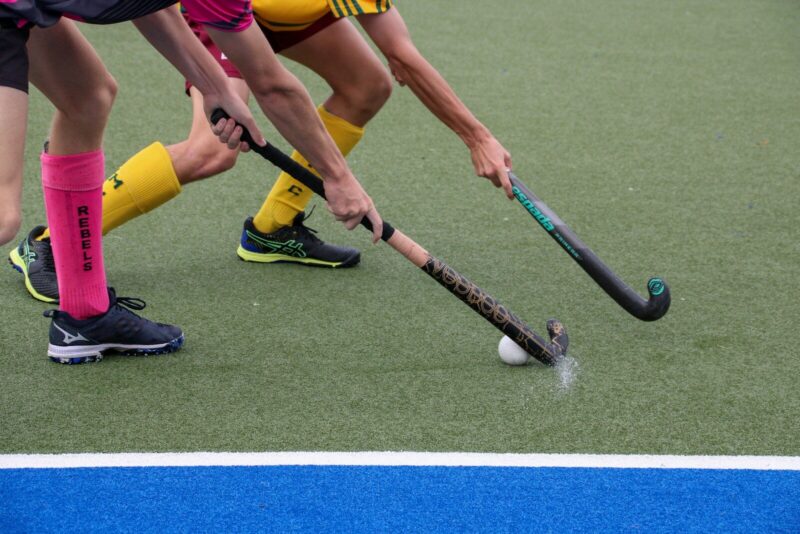
Stick and ball play
Players use the permitted face/edges of the stick under Rule 9, not its back, and must avoid dangerous or intimidating play. Above-shoulder receiving/deflecting/playing is allowed in a controlled safe manner; “sticks can never go above shoulders” is not the current complete rule.[51]
A field player cannot deliberately kick/carry/propel the ball with the body. An accidental foot/body touch only becomes an offence when the player gains advantage or intentionally positions to stop the ball that way; the stick-holding-hand exception also matters (9.11).[51]
Scoring circle
A goal needs an attacker to play the ball within the circle, followed by it crossing completely over the goal line below the crossbar without leaving the circle in the intervening sequence specified by Rule 8. A defender’s touch after the qualifying attacking circle touch does not itself cancel the goal.[51]
Example: an attacker shoots from outside and the ball reaches the goal without a qualifying attacking play inside the circle. Crossing the goal line alone is not enough. Identify who played it and where, not just who celebrated.[51]
Dangerous and raised balls
A deliberately raised hit is restricted except for a shot at goal; a flick/scoop may be raised if not dangerous. A ball causing legitimate evasive action is considered dangerous. Height alone does not resolve every case, and a legal technique can still be dangerous in context (9.7–9.10).[51]
The receiver of a falling aerial has protected initial space. The 2026 rule permits approach after the receiver touches it, with safe-interception and initial-receiver qualifications. It does not allow charging into that protected space before reception.[51]
Match shape and restarts
The baseline is four fifteen-minute quarters, with two-minute quarter breaks and ten-minute half-time, subject to allowed/competition durations. Centre pass restarts after a goal; side-line and back-line exits have different locations/entitlements. Free hits can be self-passed under Rule 13’s stationary-ball, distance and circle-entry conditions.[51]
Penalty decisions
Rule 12 distinguishes free hit, penalty corner and penalty stroke. A defender’s offence inside the circle not preventing a probable goal can give a corner; preventing a probable goal or the specified intentional offence against a player possessing/having opportunity to play the ball can give a stroke. An intentional defender offence outside the circle but within the defending 23m can also give a corner.[51]
Personal sanctions are additional: green two playing minutes, yellow at least five, red the rest of the match, with team-number reduction. They are not merely substitutions while a spare player restores eleven (14).[51]
Scope note
The existing CMS title of this overview is preserved, but its body is specifically field hockey. The future 2027 international edition is not yet applied at this source-check date; national implementation can differ.[52]
Danger decisions · Restarts · Officials. No certified umpire review is claimed.
Source-checked 2026-10-16 against the named publications. This is an editorial source check, not an umpire credential or new rule-effective date.
Sources
Source 51 https://www.fih.hockey/static-assets/pdf/fih-Rules-of-hockey-2026-final.pdf — fih-hockey-2026
Source 52 https://www.fih.hockey/about-fih/official-documents/rules-of-hockey — fih-rules-index-live
Governing bodies and competition scope
Read who governs field hockey for lawmaking, competition administration, officiating and disciplinary jurisdiction.