
Indoor handball explained: players, possession, shooting and sanctions
The standard court is forty by twenty metres with a goal area at each end. Teams have up to sixteen players on the roster under the verified IHF book, but no more than seven on court at once. The normal playing time for ages sixteen and above is two thirty-minute halves; younger groups use the book’s shorter age-specific durations (1; 2; 4).[55]
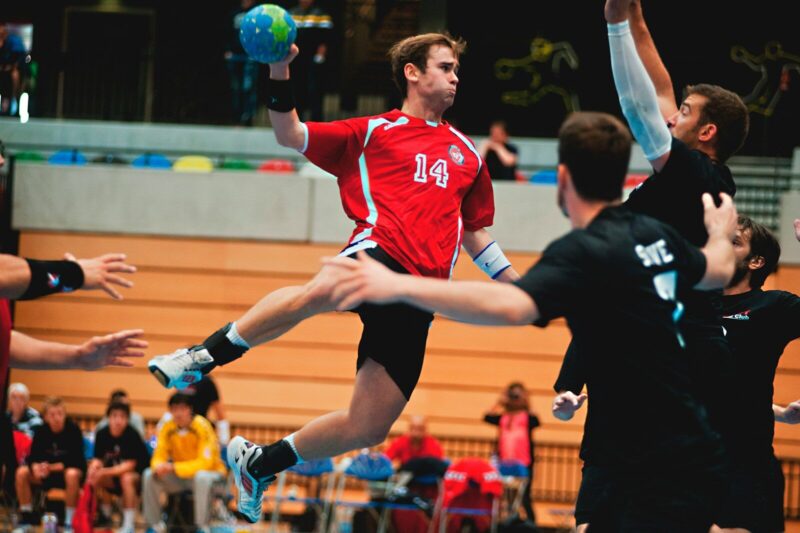
Running and dribbling
A player may hold for at most three seconds and take at most three steps after receiving/catching, with the precise airborne-landing step definition in 7:3. Dribbling can continue lawfully, but after gathering the ball the three-second/three-step limits apply and a new dribble is not freely restarted (7:2–7:4).[55]
A player can use hands, arms, head, torso, thighs and knees; foot/lower-leg contact is restricted with the specified opponent-thrown-ball exception. The ball is not played like a soccer ball simply because it falls below the knee (7:1; 7:8).[55]
Goal area and jumping shots
The goal area is generally reserved for the goalkeeper. A court player entering it can cause a goalkeeper throw, free throw or seven-metre throw depending on possession, advantage and destruction of a clear chance. Entry without disadvantage can be treated differently; not every foot near the line produces an automatic seven-metre throw (6).[55]
A shooting player can jump from outside and release before landing in the goal area, subject to the actual goal-area/contact rules. The defender cannot turn that aerial position into permission for a dangerous push; the player’s body-control risk is part of the foul assessment (6; 8).[55]
Substitutions and empty goal
Substitutes may enter repeatedly without reporting, but only after the replaced player leaves and through the team’s substitution line under Rule 4. Faulty entry can bring a two-minute suspension. An extra attacker replacing the keeper is still a court player, not a second privileged goalkeeper.[55]
Contact is regulated, not simply forbidden
Rule 8 allows specified body contact with bent arms and passive blocking with the trunk, but prohibits holding, pushing/displacing, dangerous elbows, pulling/hitting the ball out of held hands and running/jumping into opponents. Severity depends on position, body part, dynamics and consequences, not only whether someone falls.[55]
Some fouls earn direct two-minute suspension or disqualification without a preliminary yellow. Three two-minute suspensions for the same player cause disqualification; a red removes that player for the rest of the match while the ordinary in-game team reduction is separately timed (8; 16).[55]
Free throw versus seven metres
A free throw restarts after many technical/contact infringements. Seven metres is awarded when a clear chance is illegally destroyed under 14:1, with the advantage qualification in 14:2: if the attacker retains full control and scores, there is no need to manufacture a second scoring attempt.[55]
Passive play
Attacking possession must show recognizable intent to attack/shoot. A forewarning normally signals a developing passive attack; the team does not receive a guaranteed fresh allotment of slow passes. Referees can whistle earlier and Clarification 4 regulates counting/exceptions (7:11–7:12).[55]
Passive play and contact · Throws · Officials. Verified source: currently linked English IHF indoor book internally dated July 2025; no invented 2026 edition or certified review.
Source-checked 2026-10-16 against the named publications. This is an editorial source check, not a referee credential or new rule-effective date.
Sources
Source 55 https://www.ihf.info/sites/default/files/2025-07/09A%20-%20Rules%20of%20the%20Game_Indoor%20Handball_E.pdf — ihf-indoor-english-linked-current
Governing bodies and competition scope
Read who governs handball for lawmaking, competition administration, officiating and disciplinary jurisdiction.