
Water polo explained: teams, possession, goals and foul categories
Standard water polo under the February 2026 World Aquatics Regulations starts with seven players per team, one a goalkeeper. After the start a team can choose all field players, leaving the goal without goalkeeper privileges. A match start list normally has seven to fourteen players, with twelve maximum designated field players and one or two designated goalkeepers, subject to Appendix 7 (Part Six 2).[50]
Movement and handling
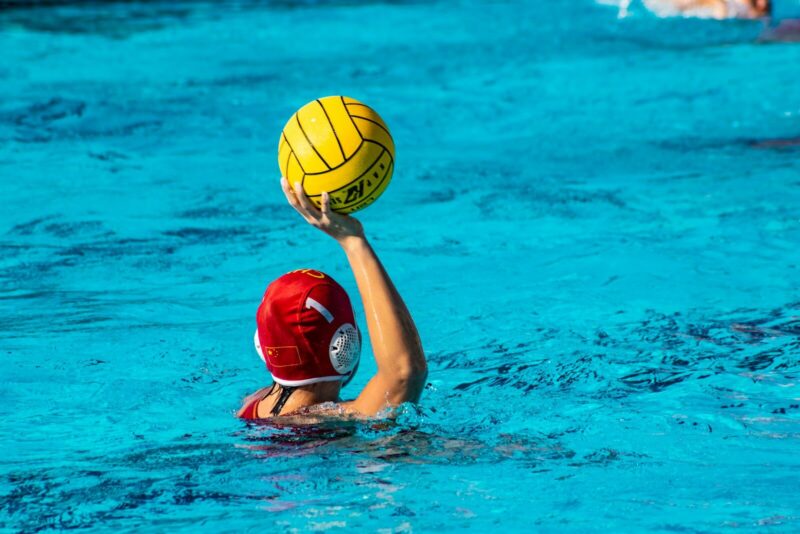
Field players normally cannot touch the ball with two hands simultaneously, strike/attempt to strike it with a clenched fist, or touch the pool floor with their legs to play/block. The goalkeeper’s defensive six-metre-area exception is specifically scoped. Taking the whole ball under when tackled or to hide/shield it is also regulated; being underwater is not blanket permission to evade the rules (8.2).[50]
A dribbling swimmer is not treated as holding/lifting/carrying the ball for every contact rule. Holding, sinking or pulling back a non-holder can be an exclusion; the rules do not make dangerous conduct lawful simply because an attacker had possession (10; 11).[50]
Time and possession
Four eight-minute periods use Actual Play, not thirty-two uninterrupted minutes of wall-clock time. Standard possession allows twenty-eight seconds without a shot, with eighteen-second rebound/corner/penalty and specified side-exit cases. An exclusion with unchanged possession uses the greater of eighteen seconds or the clock remainder, not necessarily a reduction to eighteen (4; 9).[50]
Goal and direct-shot conditions
A goal needs full passage past the front edge of the goal line between posts and below bar. A restart normally requires two intentional player touches excluding the defending goalkeeper, unless one of Rule 7.5’s exceptions applies. Those include specified direct shots and visible-put-in-play actions from the required locations (7).[50]
Example: a free throw behind the offensive six-metre line taken without delay has a direct-shot exception. For that location, both thrower’s head and ball must be behind the line; a player with head behind but ball ahead has not met that definition (7.5.1; 7.6).[50]
Ordinary, exclusion and penalty fouls
Ordinary fouls normally award a free throw; exclusions remove the offender and award the appropriate restart; penalty fouls normally yield a five-metre throw. A foul inside six metres is not automatically a penalty: likely-goal prevention and other listed actions govern (8; 10–11; 16).[50]
Exclusion and penalty fouls are personal fouls. The third excludes the player for the rest of the match, with replacement timing differing when the third is a penalty versus another exclusion. This is not three ordinary whistles of any kind (17).[50]
Substitution
During play use the exclusion re-entry or flying-substitution procedures. In the first, the outgoing player must visibly surface in the area before entry; flying substitutions require the prescribed hand touch above water. Substitution at intervals/goals/timeouts and injury situations has specific allowances (2.5).[50]
Officials and scope
The book distinguishes elite technical-official staffing from reduced non-World-Aquatics-event arrangements. Domestic/Masters/4s variations need their actual rules; the shared PDF’s many disciplines are not interchangeable (3; Part Eight; Appendix 9).[50][48]
Contact decisions · Restarts · Officials. No certified referee review is claimed.
Source-checked 2026-10-16 against the named publications. Editorial source check, not referee certification or a new rule-effective date.
Sources
Source 48 https://www.worldaquatics.com/rules/competition-regulations — world-aquatics-competition-index
Source 50 https://resources.fina.org/fina/document/2026/02/18/e6815ecc-06d9-4f0b-98e9-4c441cf5e6a3/2026-02-18_World-Aquatics_CR-Final.pdf — world-aquatics-competition-feb-2026
Governing bodies and competition scope
Read who governs water polo for lawmaking, competition administration, officiating and disciplinary jurisdiction.