
Cricket explained: runs, wickets, overs and the three main formats
Two batters occupy the pitch while the opposing side bowls and fields. In the normal eleven-a-side game, one player bowls to the striker while the non-striker is at the other end. The rectangular pitch is 22 yards long; that is the pitch length, not the diameter of the whole ground (MCC Laws 1 and 6).[29]
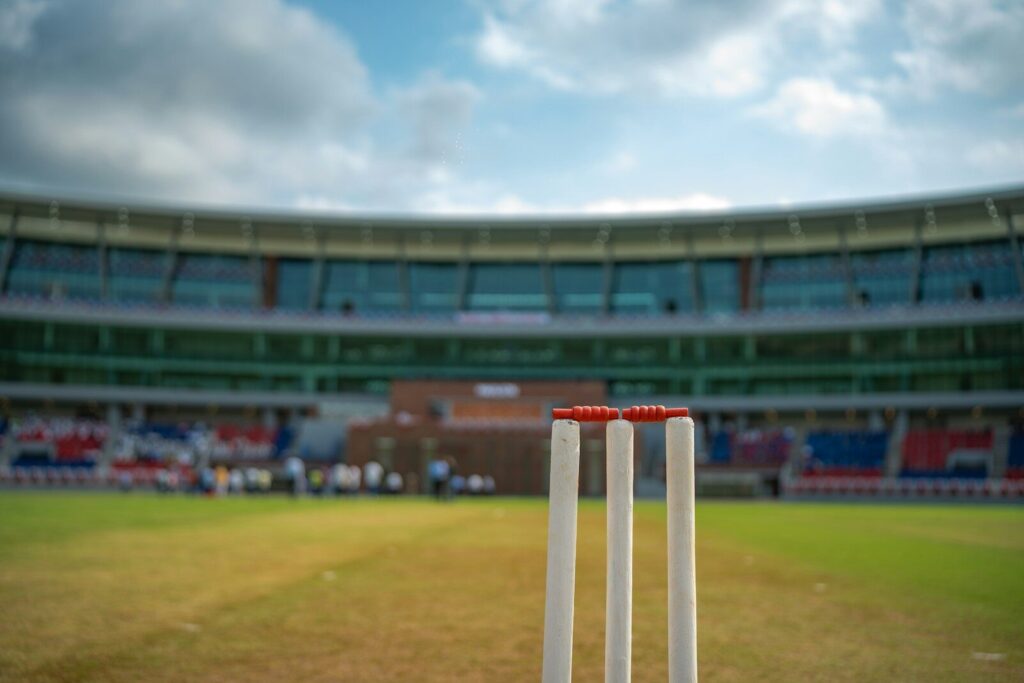
A delivery and an over
The bowler delivers from one end towards the striker’s wicket. Batters can exchange ends to complete runs, while fielders try to restrict scoring or dismiss them. An over is six valid balls; a no-ball or wide adds a penalty and normally requires another delivery. Successive overs are bowled from alternate ends (Laws 17–18, 21–22).[29]
The score 123/4 after 17.3 overs means 123 runs, four wickets lost and seventeen completed overs plus three valid balls. The “.3” is not three tenths of an over. An innings can end before its scheduled overs if all out or no further batter is available (Laws 13 and 17).[29]
Where runs come from
A run is completed when the batters cross and make good their ground at opposite ends while the ball is in play. Short-running rules can disallow a run. Ordinary boundary allowances are four and six: a six requires the bat-struck ball to clear the boundary without first being grounded inside it. Byes, leg byes, wides, no-balls and penalty runs have separate scoring rules (Laws 18–23).[29]
Leg byes are not automatic whenever the ball strikes a pad. The umpire must be satisfied that the striker attempted to play the ball with the bat or tried to avoid being hit; otherwise Law 23.3 disallows the runs through its stated procedure.[29]
Principal ways a wicket falls
- Bowled: a legal delivery fairly breaks the striker’s wicket, subject to the intervening-contact provisions (Law 32).[29]
- Caught: a legal delivery touches the bat and is fairly held before grounding, with control and boundary requirements (Law 33).[29]
- LBW: all five tests in Law 36 must be met; pad contact alone is insufficient.[29]
- Run out: the correct wicket is fairly broken while the relevant batter is out of their ground, subject to Law 38’s exceptions.[29]
- Stumped: the wicketkeeper fairly breaks the striker’s wicket with the striker out of their ground and not attempting a run, from a delivery that is not a no-ball (Law 39).[29]
These are not the only dismissals: hit wicket, obstructing the field, hit the ball twice and timed out also have defined conditions. “Handled the ball” should not be presented as a separate current dismissal category; the relevant hand contact is addressed within obstruction provisions (Laws 34–40).[29]
Test, ODI and T20I are not interchangeable
Under the October 2026 men’s ICC conditions, a standard Test is scheduled across five days with two innings per side, subject to the result and innings-completion rules. ODIs normally give each side one innings capped at fifty overs, and T20Is one capped at twenty. Weather, all-out innings and a successful chase can shorten play (respective clauses 12–16).[28][27][26]
For an uninterrupted men’s T20I, the first six overs are the Powerplay, with at most two fielders outside the marked restriction area; outside the Powerplay the maximum is five. Reduced-overs matches use a specific table, not invariably six Powerplay overs (clause 28.7).[26]
Worked scoring sequence
Start at 20/1 after 3.5 overs. A wide with no further run makes the score 21/1, still 3.5. The next valid delivery is hit for an ordinary four, making 25/1 after 4 overs. The batting score changed on both deliveries, but only the valid one completed the over (Laws 17, 19 and 22).[29]
Continue with penalties, LBW and results. Baseline: MCC fourth edition 2026; international examples specifically name the men’s format, not all domestic, women’s or junior matches.
Source-checked 2026-10-16 against the named editions. This is an editorial source check, not an umpire credential or a new rule-effective date.
Sources
Source 26 https://images.icc-cricket.com/image/upload/prd/bsxcho7ufe2pjban0wjp.pdf — icc-men-t20i-october-2026
Source 27 https://images.icc-cricket.com/image/upload/prd/bxkzkcyvfn6tvi70zh0w.pdf — icc-men-odi-october-2026
Source 28 https://images.icc-cricket.com/image/upload/prd/a8114zro5tkioifz0jqg.pdf — icc-men-test-october-2026
Source 29 https://www.lords.org/getattachment/8c96a135-beff-4a46-b5c6-2a02a7245386/Laws-of-Cricket-2017-Code-4th-Edition-(2026).pdf — mcc-laws-2017-fourth-2026
Governing bodies and competition scope
Read who governs cricket for lawmaking, competition administration, officiating and disciplinary jurisdiction.