
Steel-tip darts explained: 501, doubles, visits and the oche
In the DRA code, the normal starting score is 501 with a straight start and exact double finish unless the event format specifies otherwise. Up to three darts make a visit; a player need not use all three after a finish or bust. This guide uses the DRA 2026 book effective 31 March, not a generic rule for every electronic darts game (6.2–6.3).[62]
Reading the board
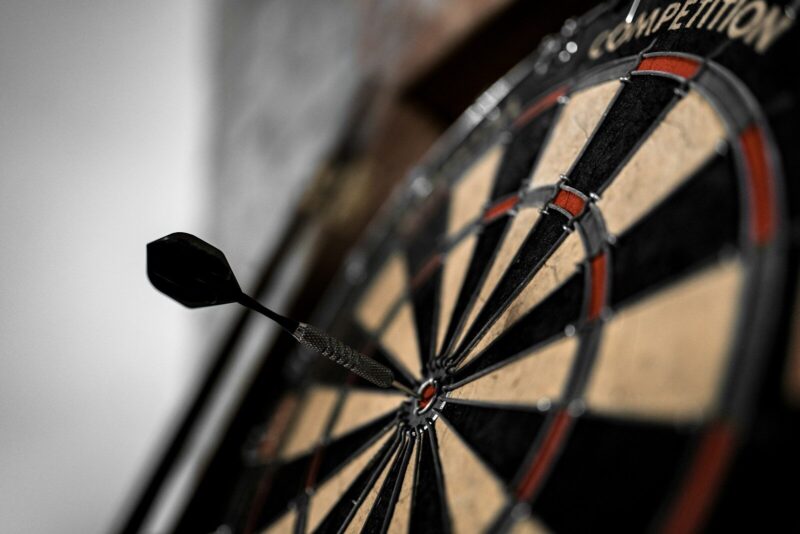
The standard board has numbered one-to-twenty sectors. The inner narrow ring trebles the number, the outer narrow ring doubles it, outer bull scores twenty-five and inner bull fifty. The segment where the point enters/touches the board determines the score; the barrel lying across another wire is not the scoring location (6.4–6.5).[62]
Example: three treble-twenties total 180, reducing 501 to 321. This is a scoring visit, not a finished leg; a player must ultimately reach exactly zero on the required double.[62]
Finishing and bust
Inner bull can finish fifty as double twenty-five. A finish is not any dart that makes the arithmetic zero: from forty, double twenty can finish, while single twenty followed by another single twenty reaches zero without a double and busts (6.3).[62]
A bust also occurs by exceeding the remaining score or leaving one. The visit does not count and play returns to the prior remainder; a player cannot bank an early dart then discard only the later busting dart. WDF 2.05 says this explicitly as the score before that throw; DRA 6.3.3 describes the reset in its wording.[62][64]
Darts that do not score
A dart bouncing off or falling out before retrieval is not re-thrown. A referee’s early score/game-shot call must be corrected if a dart subsequently falls before retrieval. Wait until the score is called/recorded before removing darts and check the actual points (6.2.7; 6.3.9; 6.4).[62]
Dropped dart versus thrown dart
A dart dropped before the deliberate action of throwing begins may be picked up and used. Once deliberately thrown, a miss/bounce-out is not a free replacement. If the player touches a dart already in the board during the visit, the visit ends early (6.2.4–6.2.7).[62]
Oche and setup
The book specifies a bull height of 1.73m and horizontal throwing distance of 2.37m from the back of the raised oche to the plumb line at the board face. This is not a measurement from the wall behind a thick board. The front foot remains grounded behind the toe edge; no treading on the raised oche (6.5.9; 6.7).[62]
Match structure and officials
Legs may be grouped into sets, with the event setting its actual winning format. Starting order is normally resolved by the prescribed bull throw unless tournament rules specify otherwise. Referees/markers call and record, but do not advise which double to aim for (6.13; 6.15.6).[62]
Finishing disputes · Visits · Officials. WDF and soft-tip procedures require their own adopted code; no certified referee review is claimed.
Source-checked 2026-10-16 against the named publications. This is an editorial source check, not a referee credential or new rule-effective date.
Sources
Source 62 https://www.thedra.co.uk/_files/ugd/20bb2f_e8eb0fa5677540c0907b333f3c4b52b4.pdf — dra-rulebook-linked-current
Source 64 https://dartswdf.com/storage/uploads/fb05b306-c92c-4f08-b512-affb092a1b3d/2018-02-28_WDF_Playing_and_Tournament_Rules_rev20.pdf — wdf-playing-tournament-rev20-2018
Governing bodies and competition scope
Read who governs darts for lawmaking, competition administration, officiating and disciplinary jurisdiction.