
Table tennis explained: table, racket, service and rally structure
Table tennis sides return the ball alternately so it touches the opponent’s court. Unlike lawn tennis, a correct serve first bounces on the server’s own court before crossing to the receiver. A return may touch the net assembly and still be good (Laws 2.6–2.8).[14]
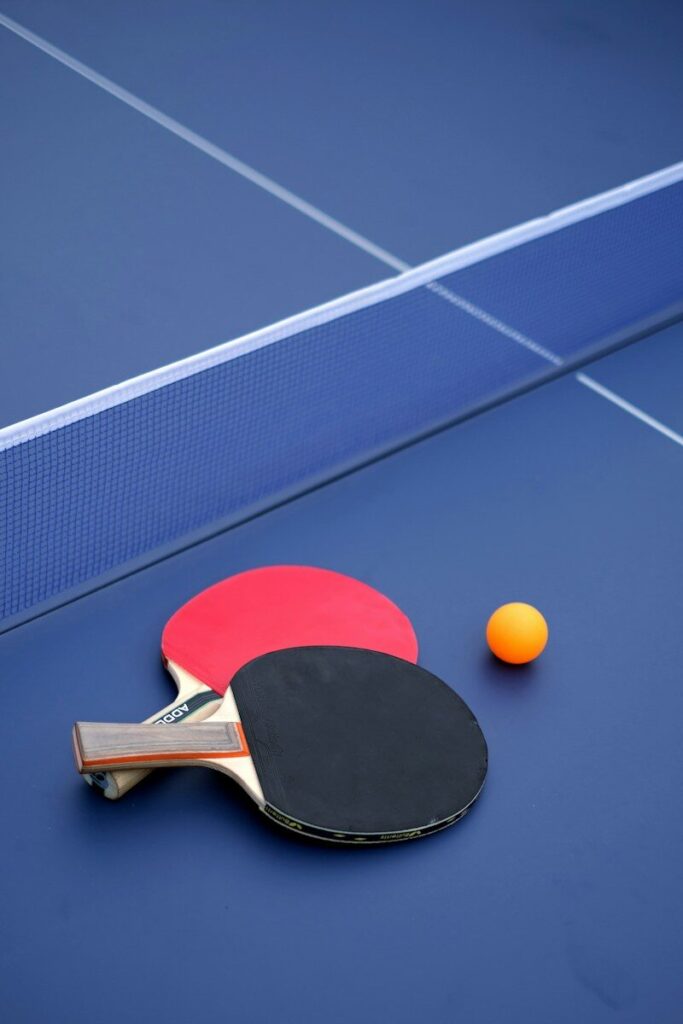
Table and net
The playing surface is 2.74 metres long, 1.525 metres wide and 76 cm above the floor. It includes the top surface, not the vertical sides. The net’s top is 15.25 cm above the surface along its length. A ball on the upper edge may therefore be in while one striking only the side is not (Laws 2.1–2.2).[14]
The ball is 40 mm in diameter and 2.7 grams, plastic and white or orange matt. The racket blade must be flat and rigid. Its two sides are not universally required to be red and black: the code requires black on one side and a bright color clearly distinguishable from black and the ball on the other, with compliant coverings (Laws 2.3–2.4).[14]
Legal service
Start with the ball resting freely on the open palm of the stationary free hand. Project near vertically at least 16 cm without adding spin; strike while it falls, above table height and behind the end line. The ball must not be hidden from the receiver, including by the doubles partner, and the free arm leaves the ball-to-net space after the toss (Law 2.6).[14]
The ball bounces on the server’s court then directly on the receiver’s. In doubles both bounces are in the right half-courts; the centre line is part of the right half-court. Singles has no diagonal restriction (Laws 2.1.6 and 2.6.3).[14]
Return and order
The receiver returns after the ball bounces on their court. A return must touch the opponent’s court, directly or after the net assembly. A ball that passes around rather than above the net is not inherently invalid if it satisfies the return law; going through or beneath the net is expressly point-losing (Laws 2.7 and 2.10.1.5).[14]
In conventional doubles the sequence is server, receiver, server’s partner, receiver’s partner, repeated. Either teammate cannot simply take the next shot as in lawn-tennis doubles. A stated wheelchair-pair exception modifies the return order (Law 2.8).[14]
Scoring and service changes
Win 11 points with a two-point lead. At 10–10 there is no cap: 11–10 continues, 12–10 wins. A match is best of any odd number of games. Service changes every two scored points, then every point at deuce or under expedite (Laws 2.11–2.13).[14]
A rally example
A serves legally, B returns, A clips the net and the ball lands on B’s upper table edge. That return can be good: rally net contact is not a let and the top edge belongs to the surface. A serve clipping the net under the service-let conditions instead stops for a replay. Name the stage of the rally before announcing the consequence (Laws 2.1, 2.7 and 2.9).[14]
International procedures versus the basic Laws
Chapter 2 sets playing Laws; Chapter 3 supplies international competition procedures including officials, intervals, advice and discipline, with its stated applicability and variation provisions. This collection labels those layers rather than assuming every informal club adopts the entire international handbook (Regulation 3.1).[14]
Playing edition: ITTF Statutes 2026, effective 1 January. Institutional updates use the separate May 2026 Constitution.[14][15] No official endorsement or certified review is claimed.
Source-checked 2026-10-15 against the named official publications. This date is an editorial source check, not a credential or a new rule-effective date.
Sources
Source [14] https://db.ittf.com/sites/default/files/public/2026-02/2026_Statutes_v1_consolidated_clean.pdf — ittf-statutes-2026
Source [15] https://db.ittf.com/sites/default/files/public/2026-08/ITTF-Constitution_2026.pdf — ittf-constitution-2026
Governing bodies and competition scope
Read who governs table tennis for ITTF, WTT, national and continental jurisdiction and the separate institutional edition.