
Wrestling explained: takedowns, exposure, falls and style differences
UWW January 2026 Olympic-style wrestling aims to win by fall or the specified points/outcome rules. It is not submission-only grappling or professional wrestling’s three-count. Freestyle and Greco-Roman share much administration but differ materially in leg use, passivity and technical-superiority margin.[70]
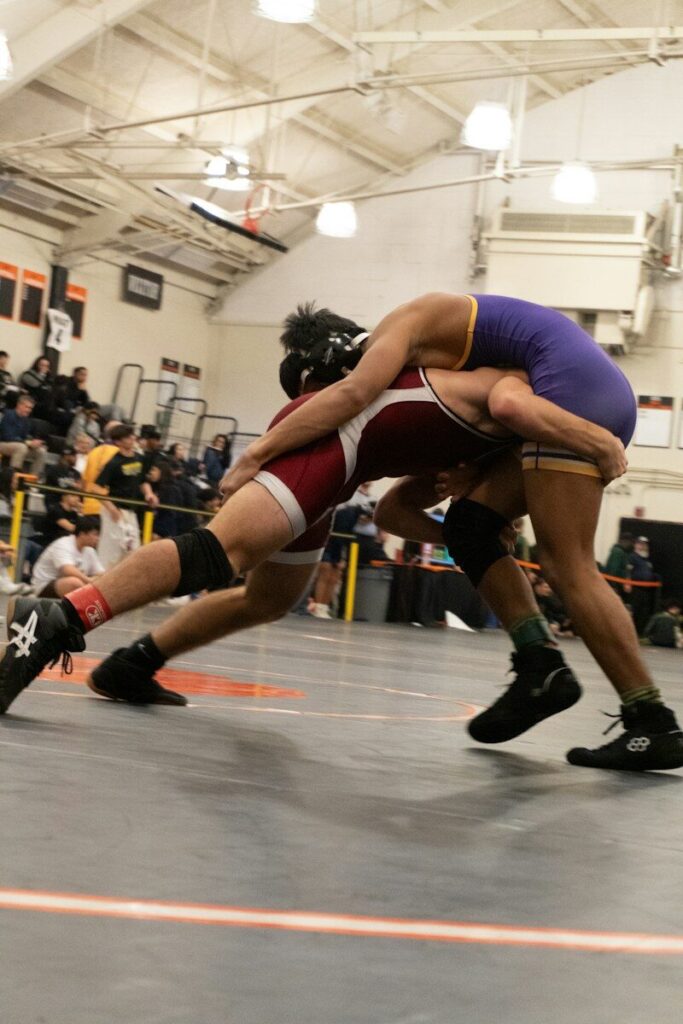
Standing and parterre
Standing action can lead to takedown/control and ground wrestling, called parterre. The lower wrestler can defend, reverse or stand up within the style’s rules. The top wrestler cannot demand a stand-up simply because the attack stopped working; the referee applies the actual activity/restart provisions (28; 44).[70]
Legal leg use depends on style
Greco-Roman forbids below-belt grasping and active leg contact against the opponent. Freestyle allows leg attacks but still forbids dangerous holds and the specified scissor-lock. Women’s wrestling follows freestyle with its double-Nelson restriction. Junior restrictions also matter (Foreword; 50–51).[70]
Points are action-specific
The January 2026 book assigns one, two, four or five according to the action. Control behind, exposure/danger, dynamic standing throws and grand-amplitude direct-danger throws have defined tests; a takedown is not automatically worth the same as a high-amplitude throw. Contact/control and continuity matter (34–38).[70]
A step-out normally gives one when a whole foot reaches the protection area without a successful hold, but deliberately pushing out with no meaningful action no longer earns that point. An ongoing completed hold can be scored instead; the boundary is not an automatic whistle erasing all action (38; 45).[70]
Fall and technical superiority
A fall needs both shoulders under complete control long enough for official confirmation. At the edge the shoulders/head conditions matter; a fall in the protection area is invalid. The mat chairman confirms before ending (42).[70]
Eight-point Greco-Roman or ten-point freestyle/women’s difference can end by technical superiority once the athletes return to neutral. Officials do not necessarily cut off a continuous scoring/pinning action the instant a displayed difference appears (27; 43).[70]
Time and equal scores
U20/U23/Senior use two three-minute periods, thirty-second break; U15/U17/veterans two two-minute periods. Add both periods’ technical points. Equal scores use the current criteria, not automatic overtime: high-value action, number of such actions, cautions and technical-point order with specified 1–1 exceptions (22; 29).[70]
Inactivity and illegal conduct
Freestyle activity time and Greco-Roman ordered-position procedures differ. Passivity is not the same as a caution for negative/illegal wrestling, and three cautions lose the bout. A serious dangerous act can have immediate consequences without waiting for three (29; 46–52).[70]
Passivity/ties · Restarts · Officials. No certified referee review or full folkstyle/domestic audit claimed.
Source-checked 2026-10-16 against the named publications. Editorial source check, not certified refereeing or a new rule-effective date.
Sources
Source 70 https://cdn.uww.org/2026-01/wrestling_rules.pdf — uww-wrestling-january-2026
Governing bodies and competition scope
Read who governs wrestling for lawmaking, competition administration, officiating and disciplinary jurisdiction.